
girl messy
examining the links between creativity, femininity, and the experience of girlhood

Thin lace, shimmering satins, and multicolored tights strewn over the carpet. Glowing bottles of skin serums, ornate perfume bottles, lipsticks, and nail polish cover the surface of vanities. Glittering jewelry, set against the hues of warming lighting, hangs from different posts and arches to keep them from tangling. Rings and earrings pool in a heart-shaped glass. Scattered magazines remain open to editorials for inspo, with red markers circling different fonts. A half-made bed piled with denim skirts, distressed jeans, and a top made of various materials over the soft comforter, patterned or plain, with a matching color scheme to the rest of the room. Hobbies, crafts, interests, and unfinished projects collect along the pastel-colored walls, hidden behind posters and photographs, some of which are framed and feature classic, idolized Hollywood actresses and actors captured in a moment of glamor and other hyperfixations.
This is Girl messy: patternized thought processes spilling from the corner and a concern for aesthetics—active Self-construction, like stepping into a kaleidoscope of memories and dreams.
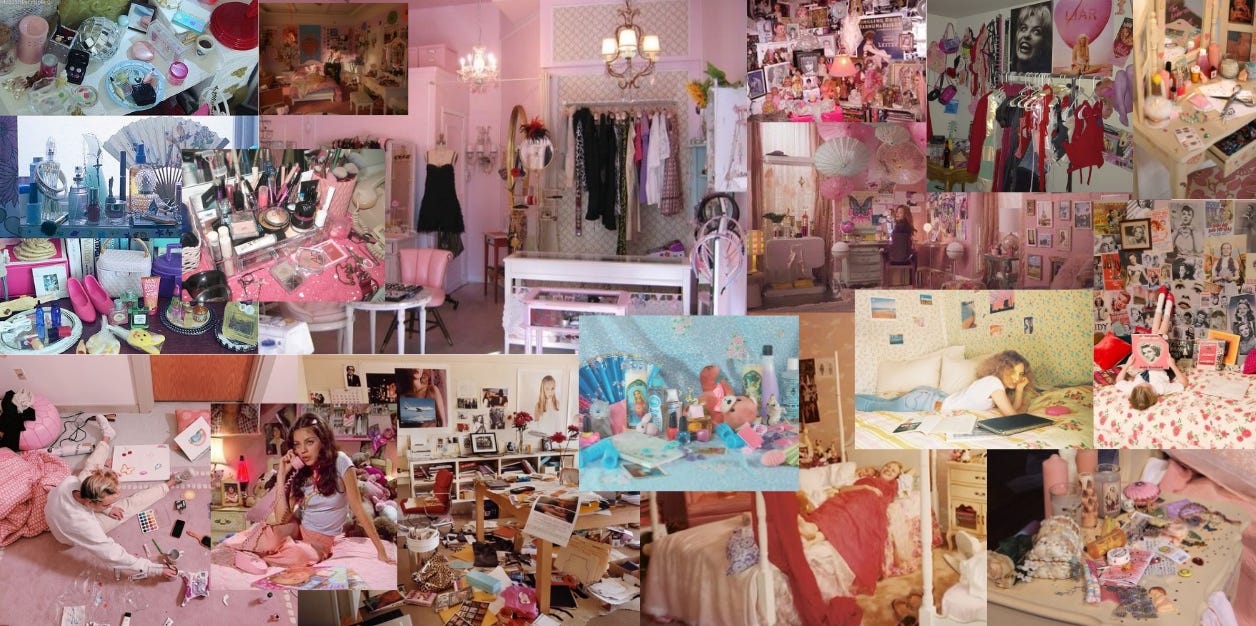
The girl’s bedroom is a capsule of performance and spectacle, concerned not with who she is at that moment, but with who she wants to become —a restless scrapbook of self-fictionalization and glimpses of Self-actualization. And even as this girl grows older, bits and pieces of her in every stage tend to remain intact throughout this mess, which is mythic, creative, and poetic; it’s not really a mess, as it is an expression of the internal mechanisms and reflections of a distinctive girlhood. It has a taste for design, patterns, colors, materials/fabrics, and, despite the clutter, is a tailored sensory experience.
Who is this sensory experience tailored for, you ask?
And what’s the difference between Girl messy… and any other sort of messiness?
To figure that out, or reach any sort of acceptable answer, we need to boil down the idealization of, at least, the above experience of girlhood, down to its essence.
Much like the serums and oils and perfumes on the desks and counters and vanities, or a stew that’s been fermenting for a few days, full of bones and soggy meat and reaching the point of putridity, we need to pick apart the notes—the underlying currents, the foundation, the elements that inform the construction of this experience, and how the reflectivity therefore informs girlhood as an experience itself of engaging in these elements and imitating the expectations/beliefs/values that are, according to the extent of their performativity, internalized.
And I’m coming from this feeling that I’m still a girl entangled in the web of figuring out how to self-represent. That’s not to be confused with the process of self-construction; even when navigating my way through hyperfixation to hyperfixation, fandom from fandom, trying out different hair styles, cuts, dyes, clothing, having a warped sense of image due to not only my increasingly over-consumption of media but its effects over how social pressures were expressed throughout my school ages and the infiltration of technology and media into learning processes, being bullied and isolated from social groups, struggling with categorization and thus having to navigate these things in hostile and volitile environments while feeling othered from my peers and relying on acts of artistic creativity and academic discipline to explore my evolving autonomy and sense of selfhood, this selfhood, and my self-awareness, was more developed than I vocally struggled to put to words to. Of course, I was a lot more dysregulated than I am now (I would like to think), and this mode of conception isn’t meant to take away from the fact that I still have a lot to learn (I’m just a baby! she cries out) or a lot of the messes I made were, in fact, just messes.
But that’s where the difference is—I’ve made messes, sure, I’ve been messy and cluttered, I’ve struggled with ‘self care’ and caring for my spaces in ways I wanted to, I’ve gotten burnt out and entered a state of survival mode where I’ve disassociated from myself and been only able to manage the most immediete, simple tasks. But for the majority of my messes, they’ve been creative messes. And I think that’s what separates Girl Messy from other messes.
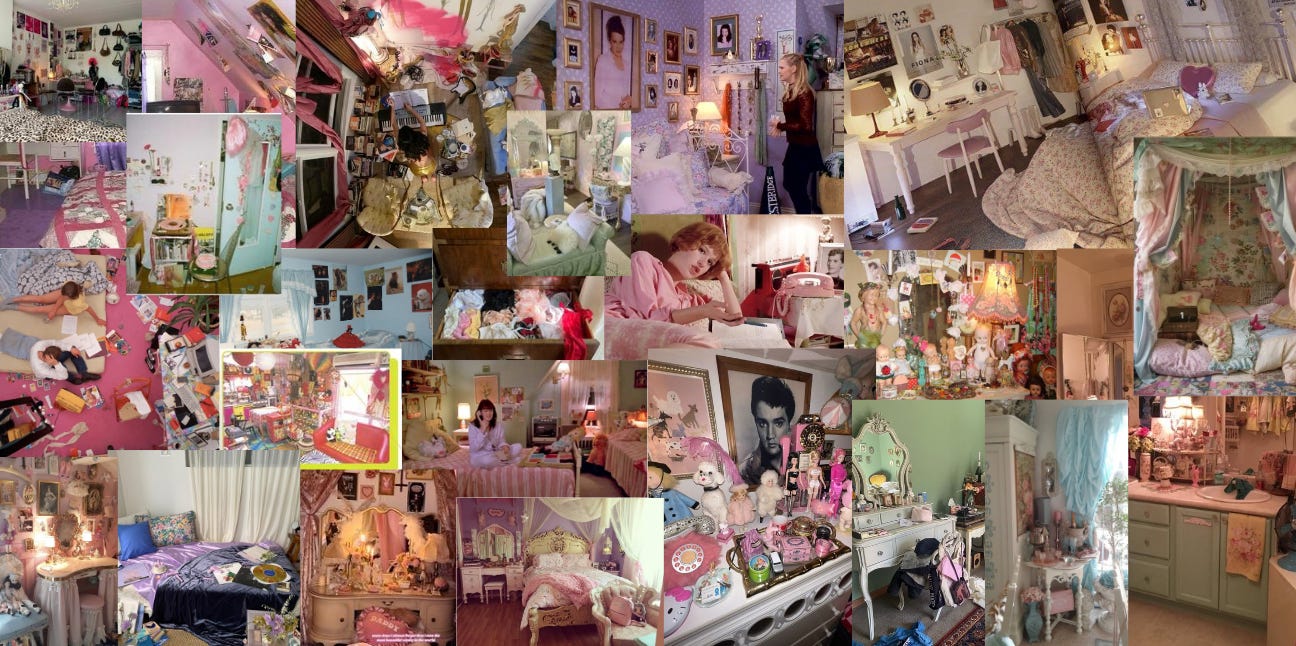
Some of you might groan and roll your eyes and say Well, isn’t that obvious or point out the fact that you obviously don’t need to be a girl to have creative messes (im looking into the camera right now, by the way), or you might not believe what I’m saying. All of those reactions are valid. I’m not making a generalized, micro-specific truth about all bedrooms; that’s not the point of this, nor the intent behind the possible implications of this creative mess, as it has to do with an experience of girlhood wherein I also attempt to explore the feelings I have about my own girlhood. Which I technically do in all of my pieces because… if you haven’t guessed already, I am a girl.
And I’ve always hated it.
Okay, I’ve also loved it. But only as I’ve gotten older, grown into myself, reclaimed what I previously denied myself the pleasures of on account of what I thought other people thought or were told they thought. Specifically regarding things labeled ‘girly’ and the associated connotations. And that’s not even acknowledging those connotations or… even getting started on everything that’s happening right now.
—Another experience I think innately shapes how girlhood is perceived and performed by both females and males and absorbed by and differentiated from other expressions of socialized gender. This very real, very prevalent, and very pervasive thing called internalized misogyny, which comes from the internalization of misogynistic rhetoric, ideology, schemas, codes, and so forth. While under today’s very bloated patriarchal right-wing and conservative society and extremist political landscape, misogyny is becoming increasingly re-normalized in its external forms. Nevertheless, the presence of its internalization doesn’t need to be re-normalized ideologically because it’s embedded in the way femininity is and has been socialized over the generations, cultural beliefs, values, and changes from 100+ years ago still influencing how the image of femininity is constructed, projected, and perceived.
There are numerous conversations still happening on the different themes, styles, and theoretical changes that have emerged as a result of the synchronicity between these internalized factors and the circumstances of/our interactions with our external environments from interpersonal to larger sociopolitical and economical events, but as this has to do with a girl’s bedroom—rather than the mess of self-assurdness, the confidence of arrogance, the relaxation of ego, pride, and the sense of belonging, what we’re met with visually is the projectile vomiting of trying to figure out what the hell you are, as a girl. What the meaning of womanhood is, more specifically, your version of it. And how that relates to your own purpose and goal in life.
There is also something to be said for identity mechanisms of reflective consciousness and reflexivity as a female and how creative energies are exercised and practiced from such a young age, whether or not they’re socialized or merely observed and modeled, and finally, the ability to say that creation itself is feminine and that the process of creativity is a feminine practice.
Moreover, the ability to and appetite for curating a space as a sensory experience. Even before physical and digital media, the girl’s room has remained a palette for sight, touch, even taste, driven by emotion, the desire to feel and express it. Things to point out: spatial emptiness in architecture leads to a psychological need to fill the space, inducing consumerism. The more money you had, the wealthier your family, and the higher up in the class system of your given society you were, the better able you were to fill this space and engage in consumerism and these other conventions. Lastly, due to previous and current models of womanhood, roles, norms, and expectations, women have largely been assigned the duties of homesteader, homemaker, and thus interior designers of not only their bedrooms but also of the space they have been forced to inhabit for so long: the home. Still, even as the experiences of girlhood and womanhood have expanded and interacted more closely with other features of society, this ‘nesting’ impulse seems to persist.
This is a curation and effort in self-expression. Self-preservation? That too.
And I think that’s due to the same architecturally exploited emotional displays and compulsions to fill empty spaces. You have something that takes up space and is empty inside? Congratulations, it’s a….
I’m so sorry…
Girls are entered into a world that still does not want them. While now, at least in western (American) society, it’s only two-faced about it, kinda, the experience is incredibly isolating, probably wherever you are, however popular you are, or… whatever… there’s an emptiness in girlhood, in learning how to be a woman, to be a person. So as a girl, there’s this compulsive need to fill our spaces—provide sanctuary from the world—and especially now, consume media that might help show or tell us what and who we are. Which is often more harmful than not, despite aiding in stimulating your brain with information that makes you go Oh, I like that… that itches my brain in a [] way… to be filed into storage and collected amongst the other identifiable aspects of what will later encapsulate who you are and the labels you define yourself by.
The only problem is that the emptiness and the void come from within and cannot be externalized in any concrete way. So no matter how prettily we clutter our surroundings and nestle into and hide ourselves away into fantastic worlds of imagination and other’s creations, no matter how much we try and project this emptiness and play-pretend filling it, I think the drive to surround ourselves with creative messes comes from an innate creative need that is inherently feminine and a result of this sensation of emptiness.
A sensation that, I might add, is critical to sensationalizing and creating spectacle reflexively to begin to create in the first place.
Girl Messy, creative destructiveness, the feminine experience, the female artist, in so many words, simply put, is another means of auto-cannibalism.
But that’s a discussion for another day.
I mentioned earlier the performativity ingrained in the girl mess, then I posed the question of who the sensory experience of that is directed toward. I’m leaving it here because the bedroom of a girl is a living, breathing thing that exhales and grows and decays. And it has eyes—everywhere. Old and young eyes, dead eyes, male and female eyes, the same eyes that look back in the mirror, the gaze of internal fantasies and projected, subjective realities. The eyes of a reflexive consciousness that imitates, mocks, and performs, even after the lights dim, the curtains close, and the crowd looks away in the darkness. Because the girl's bedroom is like a museum, not of the past, but a catalogue and scrapbook that serves the manifest purpose of actualization. To be looked back on. Not serving a function, but a theatrical display of uniformity, control, and substance.
Who is this sensory experience tailored for, you ask?
Let’s take some volunteers from that audience of yours to answer that.